Food process consistency at continuous-production scale.
Pasteurization systems, evaporators, spray dryers, and CIP cycles — all continuous, all quality-critical. Twynvex gives food manufacturers a live physics-based model of each unit operation, with predictive alerts that fire before a critical process parameter leaves specification.
Request Pilot Access
Why food processing is uniquely difficult to monitor.
Regulatory safety margins are tight
Pasteurization must achieve and hold a precise time-temperature relationship. Even a brief excursion outside specification triggers a hold or a recall. Real-time prediction of temperature profiles prevents excursions, not just documents them.
Raw material variability
Milk solids content, sugar concentration, ingredient moisture — raw material variation directly affects heat transfer and mass balance. Without a model that accounts for this, fixed setpoints lead to off-spec product.
CIP validation overhead
Clean-in-place cycles must meet documented temperature and concentration targets. A twin that tracks CIP process state in real time reduces manual verification burden and catches deviations automatically.
Pasteurization time-temperature relationship, predicted — not just recorded.
Twynvex encodes the heat transfer model for your pasteurizer — plate heat exchanger or tubular — and runs it forward in time using live flow rate, inlet temperature, and steam pressure readings. The result is a prediction of exit temperature and minimum residence time, updating every 15 seconds.
When inlet temperature drops or flow rate increases, the twin forecasts whether the outlet will remain within specification before it actually does — giving the operator a 3–4 minute window to intervene, not a post-hoc deviation report.
- Pasteurizers: HTST and LTLT heat transfer models
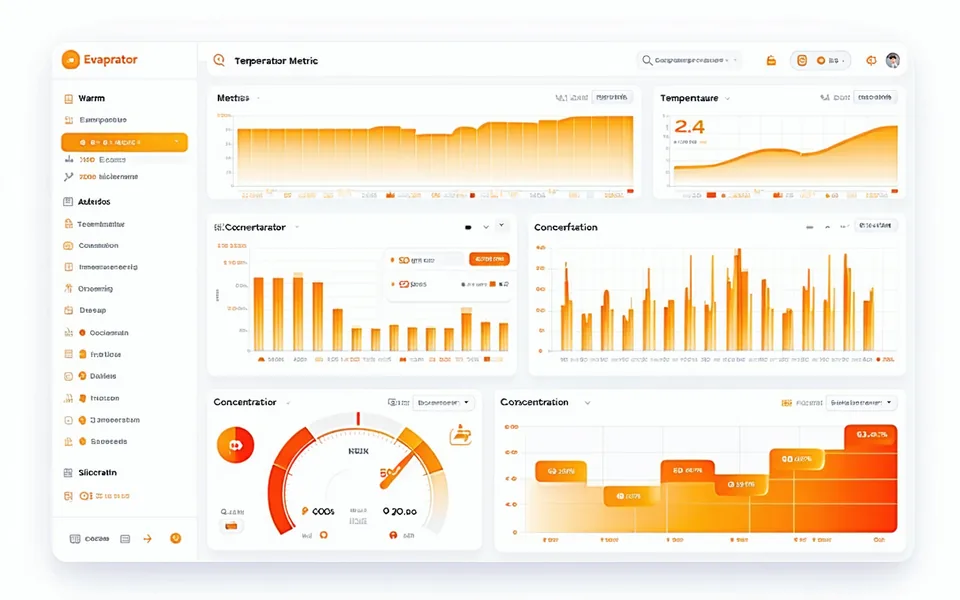
- Evaporators: multi-effect mass and energy balance
- Spray dryers: inlet air enthalpy, outlet moisture prediction
- CIP: concentration profile tracking, temperature hold time
From first OPC-UA connection to a live pasteurization prediction in under 30 days.
Our onboarding for food processing plants follows a structured sequence: sensor connection, model calibration to your specific heat exchanger geometry, and first alert configuration. We target 30 days from signed scope to live prediction.