
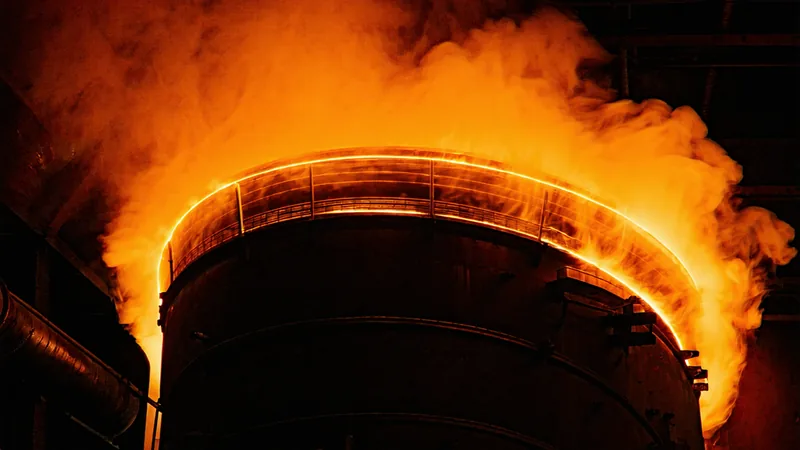
In dairy processing — concentrated milk, whey protein concentrate, condensed milk — and in juice and sugar concentration, the falling-film evaporator is the dominant piece of large-scale concentration equipment. It's energy-intensive by design: you're evaporating water, and water has a high latent heat of vaporization (2,260 kJ/kg at atmospheric pressure). Steam is the energy source. In a large dairy plant running 24 hours a day, the evaporation section can account for 40–60% of the site's total steam consumption. Modest improvements in steam economy — measured as kilograms of water evaporated per kilogram of steam consumed — translate directly to meaningful operating cost reduction.
How Falling-Film Evaporators Work (and Where Efficiency Is Lost)
A falling-film evaporator concentrates a liquid feed by distributing it as a thin film on the inside of vertical heat transfer tubes. Steam (or vapor from a previous effect, in multi-effect systems) condenses on the outside of the tubes, transferring heat through the tube wall into the falling liquid film. Water evaporates from the film, and the concentrated product falls out the bottom. The vapor from evaporation either goes to a condenser (in single-effect systems) or is used as the heating medium for the next effect (in multi-effect systems, which is the standard in large-scale dairy and sugar processing to improve steam economy).
Steam economy in a multi-effect evaporator depends on several interacting factors:
- Overall heat transfer coefficient (U): Governs how efficiently steam energy transfers through the tube wall into the product film. U degrades as fouling builds up on tube surfaces — a common occurrence in dairy processing where milk protein denatures and deposits at elevated temperatures.
- Boiling point elevation (BPE): As the product concentrates, its boiling point rises above pure water at the same pressure. BPE is a function of the solute concentration and the specific product (dairy, juice, sugar all have different BPE correlations). Running the evaporator without accounting for real-time BPE means the temperature driving force (ΔT = steam saturation temperature − product boiling temperature) may be smaller than assumed, reducing evaporation rate for the same steam consumption.
- Feed concentration variability: Raw milk composition varies seasonally and between farm batches — fat content, protein content, and total solids all affect the evaporation load and the downstream density specification for the concentrate. An evaporator set up for a 13% total-solids feed operating on a 14.5% total-solids feed will over-concentrate — hitting the density specification early and then having to reduce throughput or recirculate, both of which burn extra steam.
- Vapor compression system efficiency: In thermal vapor recompression (TVR) or mechanical vapor recompression (MVR) systems, the compressor's operating point affects the temperature lift and the effective steam economy. TVR systems are sensitive to motive steam pressure; MVR systems to compressor speed and operating point on the performance curve.
The Twin Model for a Falling-Film Evaporator
The Twynvex model for a falling-film evaporator — take a 5-effect falling-film evaporator in a dairy concentration operation as a specific example — is built on the following physical structure:
Per-effect energy balance: For each effect, the model balances the steam/vapor condensation energy against the evaporation duty in that effect, accounting for the feed enthalpy entering and the concentrate and vapor enthalpies leaving. The boiling point elevation in each effect is calculated from the current concentrate density (measured by inline density meter on the concentrate side) and a product-specific BPE correlation fit to laboratory data.
Heat transfer coefficient estimation: The overall U-value for each effect is estimated dynamically using the inferred energy balance — the measured steam pressure and condensate temperature define the steam-side temperature; the measured product inlet and outlet temperatures and flow rate define the product-side duty; U is back-calculated from Q = U × A × LMTD. When U drops more than 10% from its clean-heat baseline in any effect, the model identifies that effect as fouling and projects the steam consumption uplift if fouling continues at the observed rate.
Feed composition inference: Total solids in the raw feed isn't always measured continuously (many plants rely on daily lab analysis). The twin infers the current feed total-solids concentration from the measured feed density (via inline Coriolis or refractometer) and temperature, using the product's density-concentration-temperature correlation. This inferred feed composition is used to update the evaporation load calculation in real time — adjusting the predicted steam consumption profile and the expected concentrate density progression through the effects.
The 3-Hour Forecast: What It Looks Like in Practice
Consider a whey protein concentrate (WPC) operation in a dairy plant processing roughly 180,000 kg/day of whey. The target product is WPC-80 (80% protein dry basis), which requires concentrating the liquid whey to approximately 45% total solids before spray drying. The evaporator operates on a 6-hour CIP-to-CIP production cycle.
At T+1:30 into a production cycle, the incoming whey has shifted to a 0.8% higher total-solids content than the previous cycle — driven by seasonal variation in the incoming milk supply. The inline density sensor on the evaporator feed line shows the shift. The twin recalculates the evaporation load: 0.8% additional total solids in the feed means the evaporator needs to evaporate approximately 3.5% less water per unit of feed to reach the 45% target concentration (since the feed is already closer to the target). Under the current steam setpoints, the concentrate will actually over-shoot the density target by approximately 2.4% in about 2.5 hours.
The alert generated: "Concentrate density forecast 47.4% total solids vs. 45.0% target at T+2h 30min. Root cause: feed total solids 0.8% above design (6.2% load reduction). Recommended action: Reduce steam pressure in Effect 1 from 2.8 bar(g) to 2.5 bar(g). Estimated steam savings: 4.2% for remainder of cycle."
The operator adjusts Effect 1 steam pressure. The concentrate density trajectory straightens out toward the 45% target. The steam consumption for the cycle is measurably reduced — not dramatically, but 4–6% steam reduction in a unit that represents a large fraction of site energy costs is a number that shows up on the monthly energy report.
The Fouling Signal: Early CIP Optimization
The second major value driver for evaporator twins is the fouling signal. In dairy evaporators, fouling (primarily protein denaturation and mineral scaling on tube surfaces) is inevitable and progressive during each production cycle. The conventional practice is a fixed CIP schedule — clean every 6 hours, regardless of actual fouling state. This is conservative: the evaporator may actually have sufficient heat transfer performance to run 7 or 8 hours, or conversely, it may have fouled so severely in a high-fat-content batch that it needs CIP at 4 hours to maintain steam economy.
The twin's real-time U-value estimation provides a fouling indicator that can be used to rationalize the CIP schedule. When U drops to a threshold that indicates steam consumption has increased by more than a defined percentage (say, 12%) versus the clean-heat baseline, the twin signals that a CIP is economically warranted. This doesn't mean extending CIP intervals carelessly — food safety and sanitation requirements are fixed by HACCP plans and regulatory requirements (e.g., FDA's Grade A Pasteurized Milk Ordinance in the US), and CIP interval can only be extended with appropriate food safety validation. But within the validated operating range, optimizing CIP timing based on actual heat transfer performance is a defensible practice.
The Limits of What the Twin Can Optimize
We're not suggesting that a digital twin can solve all evaporator operational challenges. Product quality in dairy concentration is multi-dimensional: total solids is the primary concentration metric, but protein denaturation (measured by whey protein nitrogen index, WPNI), color, and microbiological load all matter for the downstream product. The twin models the mass and energy balance precisely; it does not model protein denaturation kinetics (a complex function of temperature history, pH, and protein concentration) or microbiological growth — those require specialist knowledge and are managed through separate process controls and monitoring.
Similarly, the steam reduction opportunities identified by the twin — typically 3–8% in well-maintained plants — are real but bounded. An evaporator that's already well-optimized by an experienced operator team will see smaller gains than one that has drifted away from optimal setpoints over time. The twin's value is greatest in operations where setpoint management is reactive (adjusted after quality checks) rather than predictive (adjusted ahead of quality drift). For plants already running tight process control with frequent density checks and experienced operators, the marginal improvement is smaller.
The honest framing: a falling-film evaporator twin is most valuable as an energy optimization tool for plants that (1) have significant feed composition variability, (2) run production cycles long enough that fouling progression meaningfully affects steam economy, and (3) don't currently have a real-time feed composition measurement linked to their evaporator setpoints. Where those three conditions are met, the twin pays for itself through steam cost reduction in a straightforward operating cost calculation.