
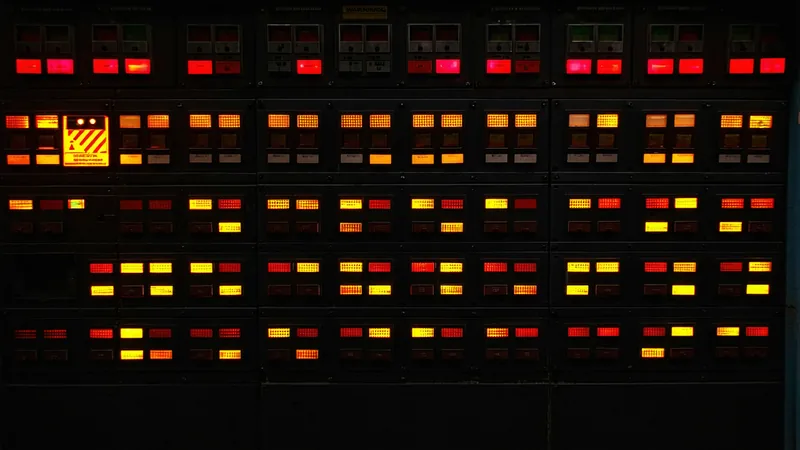
ISA-18.2, the ANSI standard for alarm management in the process industries, defines a target alarm rate of no more than one alarm per 10 minutes per operator under normal operating conditions, with a maximum acceptable rate of 10 alarms per 10 minutes during abnormal situations. Talk to a DCS operator at most continuous-process plants and ask how often those targets are met. The answer, in most cases, is that they're not. The consequences of this aren't merely inefficiency — they're safety and quality relevant. Operators who are habitually dismissing non-actionable alarms will eventually dismiss one that matters.
Why DCS Alarm Systems Become Unreliable
The root cause of industrial alarm overload is architectural. DCS alarm systems were designed around a simple model: each process variable has a high alarm and a low alarm at fixed threshold values. When the variable crosses the threshold, an alarm fires. This model was adequate when process plants had hundreds of monitored variables. Modern continuous-process plants have thousands — a mid-size chemical plant running a multi-step synthesis might have 3,000–8,000 active historian tags, each potentially carrying alarm configurations.
Alarm thresholds are set at commissioning, often conservatively wide to avoid spurious alarms during startup. They're then adjusted as the process settles — but usually only when an alarm is complained about, not proactively. The result, over years of operation: an alarm database that reflects historical adjustments rather than current process physics. Some thresholds are too tight (constant nuisance alarms on noisy sensors). Others are too wide (the alarm fires only after the deviation is already significant). Almost none are linked to downstream consequences — a temperature alarm fires because the temperature crossed 95°C, not because that temperature will cause product quality to degrade in 3 hours.
The NAMUR working group on alarm management, the Engineering Equipment and Materials Users' Association (EEMUA Publication 191), and the ISA-18.2 standard all document this problem extensively and provide guidance for alarm rationalization programs. The guidance is sound, and alarm rationalization projects do improve alarm systems. The limitation: rationalization is a retrospective, point-in-time exercise that requires significant engineering effort and then degrades again over time as the process and instruments change.
The Operator Behavioral Response to Alarm Overload
The human response to continuous low-signal-to-noise alarm environments is well-documented in process safety literature and in industrial accident investigations. Operators develop coping strategies: alarm shelving (temporarily suppressing an alarm to stop a nuisance), alarm flooding acceptance (acknowledging all alarms in bulk during high-alarm periods), and pattern-based filtering (learning which alarms can be safely ignored based on shift experience).
These strategies work, most of the time. The problem is that they erode the discrimination ability that makes an alarm system valuable. An operator who has learned that "temperature high on TT-214 always comes up around 2 PM due to ambient heat and doesn't mean anything" has, in their mental model, correctly deactivated a nuisance alarm. But if TT-214's 2 PM spike is ever accompanied by a simultaneous control valve malfunction that actually does mean something — the conditioned response fires, and the real alarm is dismissed along with the nuisance.
This is not an operator performance failure. It's a systems design failure. The alarm system was not designed to help operators discriminate between significant and insignificant conditions — it was designed to fire at threshold crossings, leaving the operator to perform the significance judgment manually based on experience and context.
What Outcome-Linked Alarming Changes
Outcome-linked alarming is conceptually simple: an alarm fires not when a process variable crosses a fixed threshold, but when the digital twin's forward simulation projects that a defined outcome will be missed within a specified time horizon. The alarm carries with it the predicted outcome, its estimated time, the causal chain, and optionally a set of recommended interventions.
This changes the operator's experience in several ways:
- Every alarm is actionable by design. The alarm fires because the model predicts a consequence worth acting on. If the TT-214 temperature spike at 2 PM doesn't cause a downstream consequence (the process can absorb it), no alarm fires. If it coincides with a valve issue that creates a compound problem, the model detects the compound interaction and fires one alarm describing the actual predicted outcome.
- The alarm contains diagnostic information. Instead of "Temperature High: TT-214 = 96.2°C (limit: 95°C)," the operator sees: "Distillate purity forecast 97.1% vs 98.5% spec in 3h 40min. Contributing factors: TT-214 above design +1.2°C (20%), reflux ratio 4% below setpoint (80%). Suggested action: Increase reflux ratio to 2.52." The alarm has already done the root-cause analysis — not perfectly, but as a starting point.
- Alarm volume drops substantially. In a twin-linked alarm system, the suppression mechanism is not ad-hoc (an operator shelving a nuisance) but systematic: process deviations that the model determines will not propagate to a consequence within the forecast horizon don't generate alarms. The alarm rate reflects consequence-relevant events, not threshold crossings.
The Transition: Running Both Systems in Parallel
A reasonable concern: if outcome-linked alarms from the twin are the only alert mechanism, and the model has an error — says no consequence is predicted when one is actually developing — a process problem could go undetected. This concern is legitimate, and it argues for a parallel architecture rather than replacement.
The practical approach for a twin deployment: keep the existing DCS alarm system running (it's the certified safety layer, it's been validated, it's not changing). Add the twin's outcome-linked prediction alerts as a supplementary advisory layer — presented on a separate display or in a distinct interface area, clearly labeled as predictive rather than reactive. The DCS alarms remain the safety backstop; the twin alarms are the early warning and decision support layer.
Over time, as operators build trust in the model's predictions through a track record of forecast accuracy, and as the alarm rationalization data from the twin (which deviations never lead to consequences?) feeds back into the DCS alarm database, the two systems converge. The DCS alarm thresholds can be progressively rationalized based on model evidence for which threshold crossings actually matter. This is a more principled path to alarm rationalization than the traditional approach of periodic manual review — it's evidence-based, continuous, and grounded in the process physics.
Measuring the Impact
The metric that matters is not "number of alarms per shift" in isolation — it's the alarm response rate: the fraction of fired alarms that result in an operator action within a defined response window. A system with 50 alarms per shift where 45 are acted on appropriately is better than a system with 200 alarms per shift where 180 are dismissed and the 20 that matter are lost in the noise.
For plants implementing outcome-linked alarming alongside their existing DCS system, the leading indicator to track is the "nuisance alarm rate" on the DCS side — alarms that fire and are acknowledged without any operator action or notes. A well-rationalized, physics-grounded alarm configuration should push this below 20% of alarm volume. In most plants with aging alarm systems, it's 60–80%.
Getting that ratio right is the difference between a control room where the alarms are a reliable signal and one where they're background noise. Process safety and product quality both depend on operators taking alarms seriously. That requires giving operators alarms that deserve to be taken seriously.